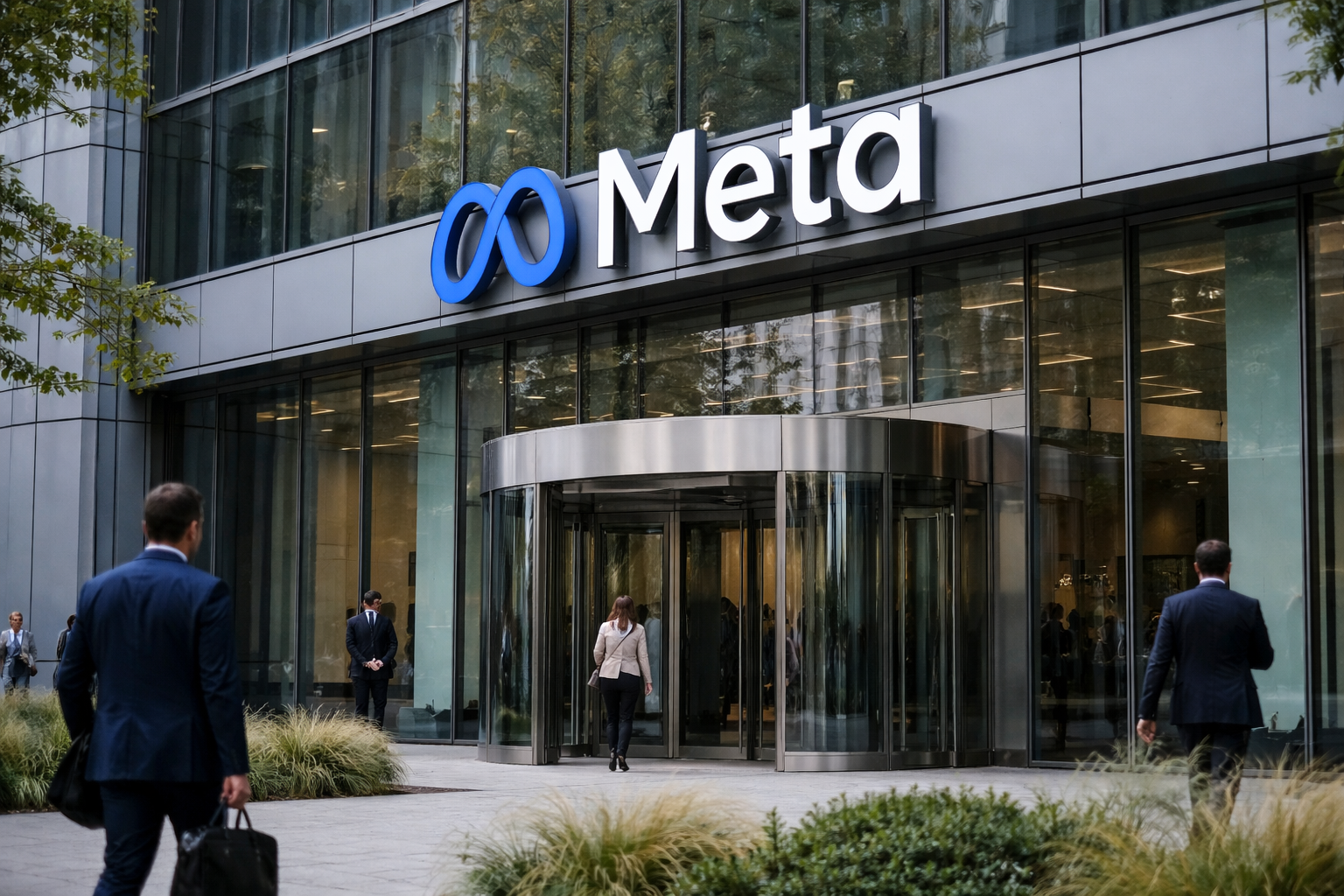
Meta stock fell as much as 10% after hours on Wednesday as weaker profit, falling cash flow and heavy AI spending overshadowed record revenue.
The decline could erase well over $100 billion in market value if it holds when regular US trading begins on Thursday.
Second-quarter revenue rose 28% to $60.8 billion, but net income fell 14% to $15.9 billion. Earnings of $6.18 a share missed the $7.19 FactSet consensus.
The reaction exposed a widening divide.
Meta’s advertising machine remains powerful, but Wall Street increasingly wants proof that spending on data centres, models and computing capacity will create profitable businesses beyond ads.
Record revenue cannot hide Meta’s exploding cost base
Meta’s core operation did not collapse, as advertising revenue increased 27% to $59.4 billion as ad impressions rose 14% and the average price per advertisement climbed 12%.
Daily users across its family of apps reached 3.6 billion.
The problem was the cost of delivering that growth. Quarterly expenses surged 55% to $42 billion, including $2.4 billion of legal charges and $1.2 billion of severance expenses.
Free cash flow dropped 91% to only $784 million, weakening one of the strongest traditional arguments for owning Meta.
The company narrowed its 2026 capital-spending forecast to $130 billion-$145 billion from $125 billion-$145 billion, effectively raising the floor.
Third-quarter revenue guidance of $61 billion-$64 billion implies growth of about 22% at the midpoint, a clear slowdown from the June quarter.
D.A. Davidson analyst Gil Luria retained a Buy rating but cut his price target to $700 from $850.
MarketWatch reported that he called the outlook a “significant top-line deceleration”, showing that even bullish analysts are lowering expectations.
Why RBC thinks Wall Street may be missing the bigger story
RBC Capital Markets analyst Brad Erickson offers the contrarian case.
In a July note published before the results, he described Meta as the “biggest opportunity for narrative improvement” among hyperscalers.
Erickson argued that investors were concentrating on infrastructure costs while assigning too little value to subscription products, services for small businesses, custom chips and the potential Meta Compute business.
Selling excess computing capacity could create a new revenue stream, while paid AI services and business agents could reduce Meta’s dependence on advertising.
He said commentary around custom chips and Meta Compute could produce a significant narrative shift.
However, he also warned that management must provide concrete metrics, clear use cases and a credible timetable for scaling those businesses before sentiment improves.
That condition matters as Meta still generated about 98% of its quarterly revenue from advertising, leaving the emerging AI opportunities commercially interesting but financially unproven.
Analysts said Meta must demonstrate that its AI investments can generate meaningful revenue, rebuild free cash flow as exceptional costs ease, and create new businesses capable of supporting annual capital expenditure of up to $145 billion.
The post Meta stock sheds billions after earnings but this analyst thinks Wall Street is wrong appeared first on Invezz